Background


Richard Linklater's new film, Boyhood (2014), continues his fascination with the passage of time as explored initially in Slacker (1991), and then in the trilogy of films Before Sunrise (1995) Before Sunset (2004) and Before Midnight (2013). This time Linklater compacts 12 years of one boys life into one unique film.


Boyhood is comprised of all the moments in life we might not think of as dramatic, a narrative anathema to most films, yet together they form a dramatic and emotional whole. It's the little things which build over time that make a life a tale to tell, not just the grand dramas. There's a Charles Bukowski line from his poem, 'The Shoelace', which goes some way to evoking that idea of the little things, of lost time, although with a lot more tragedy:

it’s not the large things that
send a man to the
madhouse. death he’s ready for, or
murder, incest, robbery, fire, flood…
no, it’s the continuing series of small tragedies
that send a man to the
madhouse…
not the death of his love
but a shoelace that snaps
with no time left …


This idea couples with accumulation and the passage of time is represented rather beautifully towards the close of the film where Mason (Ellar Coltrane) finds his mother (Patricia Arquette) in tears reflecting on how quickly time has passed and how much has changed. All of those little things accumulate and they form the backbone of life, a magical poetry that can bring you to tears, a kind of quiet Proustian agony.

Theres been discussion about the similarities with Michael Apted's Up documentary series, and Linklater himself has pointed to Truffaut's Antoine Doinel series, but this film stands alone in its originality in fully encompassing coming of age with the same actors over time. 


The first time I saw the film I was reminded of Terence Malick's Tree of Life (2011) and felt there was kinship in that both films covered rites of passage, family and the passage of time in America.

Malick's film is visually stunning, and is in keeping with the visual patterns explored in his other recent films, The New World (2005) and To The Wonder (2012), catching images of life and memory from defamiliarising angles, showing the world from perspectives we don't always see in cinema. What Malick in Tree of Life captured was 'sense' of life, an instinctual sense of existing, relying less on traditional narrative dialogue and more essentially primitive, child-like visual images of wonder, of touch, of smell, of sight, often verging on the pretentious, but equally building a story of American family life in the 20th Century.

In his review of Boyhood, film writer
Michael Smith identifies the Malick connection, but notes Malick's film couched in "pretentious sequences involving digital dinosaurs and voice-over narration cloaked in cosmic-spiritual hokum" something from which Linklater's film entirely avoids.

The use of music in Boyhood is also intrinsic to its overall effect, much in the way Martin Scorsese selects music for effect Linklater does the same here, and the choice of Coldplay's song Yellow, to open the film recontextualised it and perfectly embodied that feeling of a time and place, tugging ever so slightly at the heart strings, I was reminded again of how fond I once was of that song and how fond I am of this film the masterpiece Linklater has been working towards from the beginning.


'Finding Vivian Maier' is creating quite a stir, with audience and critics alike placing her in the posthumously discovered company of Emily Dickinson, Franz Kafka and Vincent Van Gogh.

Brian Eno said that we're living in the time of the 'artist as curator, a connector of things, a person who scans the enormous field of possible places for artistic attention', and given the explosion of available cultural fragments in the internet age, and the almost incessant abundance of every fragment of culture, past and present, digitised forever, we've gone beyond Walter Benjamin's The Work of Art in the Age of Mechanical Reproduction.

Director, and inevitable curator himself, Jon Maloof, discovered Maier's work at a 2007 auction. Maier lived for her work, yet it was her most closely guarded secret. Here Maloof acts as a code breaker, assembling her life from her photographic work and in the process aiming to cut through the mystery of why a woman so obviously gifted failed to make any meaningful attempts to show her work to others.

A mystery to all who knew her, Maier's work as a nanny from the 1950s to the 1980s was a practical convenience to allow her to subsist, to travel and to take photographs. She absorbed the world around her but it never absorbed her. As she says, she was a kind of spy. Through her photographs we enter into a kind of anthropological study of post-war American life including the lives of those she cared for.

One thing each of the families she worked for share in common is their perception of Maier as a distant, unknowable person. Although they each had slightly different stories to tell and provided different fragments of her personality, they each came to the same conclusion: Maier with her a faux-French accent, gave different names to different people, rewrote her early history, stood apart from others, viewed human experience at a distance, yet her distance from others allowed her to capture the reality of everything around her as voyeur.

The images she made display a warmth and humour as well as a sorrow and reveal her interest in morbid stories of human suffering. She captured the very essence of the culture, from the high to the impoverished lows yet during her lifetime nobody knew this. Her work blends dashes of Henri Cartier-Bresson, Diane Arbus and Robert Frank and some of her very best images are as good as anything those established artists produced.

Stealing intense and personal images of those she encountered, often without their knowledge, while remaining to those she photographed and those acquainted with her hidden from view, Maier's photographs are a revelation and a leave you wondering how many unknown artists must be working today under the shadows of their own anonymous lives.

Beneath the visage, photography became the one true place where she could express herself, not through meaningful contact with others, but by watching them and questioning them. She wanted to understand the world, perhaps before she allowed the world to understand her, or by collecting fragments of the world around her she might make sense of her own role in it. What we discover is that this mere act itself was her life, she lived to watch others live.

Ultimately we are left with the enigma, yet we come to understand this was someone immensely proud and confident of their craft, but who was never able to fulfil what was most certainly a desire to have her work seen by others. Maier was most herself when observing others from behind a lens. Without it she would remain anonymous and invisible, her life's work hidden and her mystery intact, until Jon Maloof came along.


Jesse and Celine, it's good to be back. 

Before Midnight is the third instalment in Richard Linklater's exceptional and unique series of films which trace the ongoing relationship between Jesse (Ethan Hawke) and Celine (Julie Delpy) from the streets of Vienna and Paris to southern Greece and the rupturing unease of parenthood and middle age. It's hard to accept that nearly 20 years have passed since the idyllic young couple met on a train. 

Jesse and Celine are still to an extent the same idealistic young lovers who met on a train and wandered the streets of Vienna and later Paris, but this time they're older, they're wiser and where else could the wisdom and the tragedy and trajectory of theirs and every romance be embodied but in Greece. Their relationship has passed through the youthful phase of dreamy romanticism and although there are moments of the tenderness of the first two films, Before Midnight adds a richer and tougher flavour. It's the transition from innocence to experience.

Richard Linklater has a way of working with real-time scenes like nobody else in cinema today and it has been a theme since his first picture Slacker (1991). Particularly great is a sequence at the beginning of the film where the couple are driving with their two young children from the airport to the Greek villa they've been holidaying at. As with the walking scenes in both Before Sunrise (1995) and Before Sunset (2004) it displays the level of sophistication and fluidity of the dialogue Delpy and Hawke have developed and allows them opportunities to talk more conversationally than perhaps other scenarios would. And because of this their dialogue, their interaction are immediately recognisable as genuine, as something we've all experienced, without any trace of pretence. Again and again in each of the films Linklater has returned to this technique to reveal how the characters are just like us. 

Here is a smart and witty film which tastefully rounds off the series of films which relate the eternal struggle of dualities in relationships and the yearning to retain a newness and innocence through dichotomies (Jesse's melancholy at having partially lost his son to create a new life with Celine) and power struggles, and the yearning for a true communication and understanding. How many couples will watch this set of films and recognise themselves and over and over again, year after year like Jesse and Celine in Before Midnight try and get back to the start again.


Afternoon slips into evening, the sky is the same white veil colour as the film I'm watching, it's so close and at any moment it might rain. A film that captures white shadows. Every frame numbing. Every word poetry, every movement breathes a new angle on existence, a new perception.

Ingmar Bergman at his finest:


Bergman is one of my favourite film makers and like all those who reach certain artistic heights, they have inspiring things to say about the genesis of their art and how they continue to express themselves. This is a lengthy piece by Bergman, but I feel it deserves to be read.


EACH FILM IS MY LAST
by Ingmar Bergman
From Essays in Criticism (Oxford University Press, 1975)

Artistic creation always manifested itself to me as hunger. I acknowledged it with a certain satisfaction, but during my conscious life I never asked myself what caused this craving. In the last few years the hunger has diminished and been transformed into something else; now I am anxious to find out what the reasons for it were. I have an early childhood memory of my desire to show off achievements: proficiency in drawing, playing ball, the first swimstrokes. I had a strong need to draw the grownups' attention to these signs of my presence in the external world. I never felt that people took enough interest in me. When reality was no longer sufficient, I started to invent things: I entertained my friends with tremendous stories of my secret exploits. They were embarrassing lies, which failed hopelessly when confronted with the level-headed scepticism of the world around me. Finally I withdrew, and kept my dream world to myself. A child looking for human contact, obsessed by his imagination, had been quickly transformed into a hurt, cunning, and suspicious daydreamer.
But a daydreamer is no artist except in his dreams.


The need to be heard, to correspond, to live in the warmth of a community, was still there. It grew stronger the lonelier I grew. It goes without saying that film became my means of expression. I made myself understood in a language going beyond words, which failed me; beyond music, which I did not master; beyond painting, which left me indifferent. I was suddenly able to correspond with the world around me in a language spoken literally from soul to soul, in phrases which escaped the control of the intellect in an almost voluptuous way. With the whole stunted hunger of a child I seized upon my medium and for twenty years, tirelessly and in a kind of frenzy, I supplied the world with dreams, intellectual excitement, fantasies, fits of lunacy. My success has been amazing, but at bottom it is an insignificant sequel.

I do not underestimate what I may have achieved. I think that it has been and perhaps still is of importance. But now I can see the past in a new and less romantic light; that is security enough for me. Today my situation is less complicated, less interesting, above all less glamorous than it was. To be completely frank, I experience art (not only film art) as insignificant in our time: art no longer has the power and the possibility to influence the development of our life.

Literature, painting, music, film, and theatre beget and bring forth themselves. New mutations, new combinations arise and are annihilated; the movement seems–seen from the outside–nervously vital. With magnificent zeal the artists project to themselves and to a more and more distracted public pictures of a world that no longer cares what they like or think. In a few countries artists are punished, art is considered dangerous and worth stifling and directing. On the whole, however, art is free, shameless, irresponsible; the movement is intense, almost feverish, like a snake's skin full of ants. The snake is long since dead, eaten, deprived of his poison, but the skin is full of meddlesome life.


If I have become one of these ants, I must ask myself if there is any reason to continue my work.
The answer is yes. Although I think that the stage is an old, beloved kept woman, who has seen better days. Although I and many other people find the Wild West more stimulating than Antonioni and Bergman. Although the new music gives us the sense of being suffocated by mathematically rarefied air. Although painting and sculpture, sterilized, decline in their own paralyzing freedom. Although literature has been transformed into a pile of words without any message or dangerous qualities....
I think that people today can dispense with theatre, because they exist in the middle of a drama whose different phases incessantly produce local tragedies. They do not need music, because every minute they are exposed to hurricanes of sound passing beyond endurance. They do not need poetry, because the idea of the universe has transformed them into functional animals, confined to interesting–but from a poetical point of view unusable–problems of metabolic disturbance. Man (as I experience myself and the world around me) has made himself free, terribly and dizzyingly free. Religion and art are kept alive as a conventional politeness toward the past, as a benign, democratic solicitude on beha1f of nervous citizens enjoying more and more leisure time....

If I consider all these troubles and still maintain that I want to continue to work in art, there is a simple reason. (I disregard the purely material one.) The reason is curiosity. A boundless, insatiable curiosity, that is always new and that pushes me onwards–a curiosity that never leaves me alone and that has completely replaced my craving for community. I feel like a prisoner who, after serving a long term, suddenly is confronted with turbulent life. I note, I observe, I keep my eyes open; everything is unreal, fantastic, frightening, or ridiculous. I catch a flying grain of dust, maybe it is a film–what importance does it have? None at all, but I find it interesting and consequently it is a film. I walk around with the grain of dust that I have caught with my own hands. I am happy or sad. I jostle the other ants, together we accomplish an enormous task. The snake's skin moves.

This and only this is my truth. I do not request that it be valid for someone e1se, and as a consolation for eternity it is of course rather meager. As a basis for artistic activity during some future years it is completely sufficient at least for me. To devote oneself to artistic creation for one's own satisfaction is not always agreeable. But it has one great advantage: the artist lives exactly like every other living creature that only exists for its own sake. This makes a rather numerous brotherhood....

THOU SHALT

Experience should be gained before one reaches forty, a wise man said. After forty it is permissible to comment. The reverse might apply in my case–no one was more certain of his theories and none more willing to elucidate them than I was. No one knew better or could visualize more. Now that I am somewhat older I have become rather more cautious. The experience I have gained and which I am now sorting out is of such a kind that I am unwilling to express myself on the art of the filmmaker.... The only real contribution the artist can make is his work. Thus I find it rather unseemly to get involved in discussion, even with explanations or excuses.

The fact that the artist remained unknown was a good thing in its time. His relative anonymity was a guarantee against irrelevant outside influences, material considerations, and the prostitution of his talents. He brought forth his work in spirit and truth as he saw it and left the judgment to the Lord. Thus he lived and died without being more or less important than any other artisan. In such a world flourished natural assurance and invulnerable humility, two qualities which are the finest hallmarks of art.

In life today the position of the artist has become more and more precarious: the artist has become a curious figure, a kind of performer or athlete who chases from job to job. His isolation, his now almost holy individualism, his artistic subjectivity can all too easily cause ulcers and neurosis. Exclusiveness becomes a curse which he eulogizes. The unusual is both his pain and his satisfaction....

The Script

Often it begins with something very hazy and indefinite–a chance remark or a quick change of phrase, a dim but pleasant event which is not specifically related to the actual situation. It has happened in my theatrical work that I have visualized performers in fresh make-up but in yet-unplayed roles. All in all, split-second impressions that disappear as quickly as they come, forming a brightly colored thread sticking out of the dark sack of the unconscious. If I wind up this thread carefully a complete film will emerge, brought out with pulse-beats and rhythms which are characteristic of just this film. Through these rhythms the picture sequences take on patterns according to the way they were born and mastered by the motive.

The feeling of failure occurs mostly before the writing begins. The dreams turn into cobwebs, the visions fade and become grey and insignificant, the pulse-beat is silent, everything shrinks into tired fancies without strength and reality. But I have decided to make a certain film and the hard work must begin: to transfer rhythms, moods, atmosphere, tensions, sequences, tones, and scents into a readable or at least understandable script. This is difficult but not impossible.

The vital thing is the dialogue, but dialogue is a sensitive matter which can offer resistance. The written dialogue of the theatre is like a score which is almost incomprehensible to the ordinary person; interpretation demands a technical knack and a certain amount of imagination and feeling. One can write dialogue, but how it should be handled, the rhythms and the tempo, the speed at which it is to be taken, and what is to take place between the lines–all that must be left out, because a script containing so much detail would be unreadable.

I can squeeze directions and locations, characterizations and atmosphere into my film scripts in understandable terms, but then I come to essentials, by which I mean montage, rhythm and the relation of one picture to the other–the vital "third dimension" without which the film is merely dead, a factory product. Here I cannot use "keys" or show an adequate indication of the tempos of the complexes involved; it is impossible to give a comprehensible idea of what puts life into a work of art. I have often sought a kind of notation which would give me a chance of recording the shade and tones of the ideas and the inner structure of the picture. If I could express myself thus clearly, I could work with the absolute certainty that whenever I liked I could prove the relationship between the rhythm and the continuity of the part and the whole.... Let us state once and for all that the film script is a very imperfect technical basis for a film.

Film is not the same thing as literature. As often as not the character and substance of the two art forms are in conflict. What it really depends on is hard to define, but it probably has to do with the self-responsive process. The written word is read and assimilated by a conscious act and in connection with the intellect, and little by little it plays on the imagination or feelings. It is completely different with the motion picture. When we see a film in a cinema we are conscious that an illusion has been prepared for us and we relax and accept it with our will and intellect. We prepare the way into our imagination. The sequence of pictures plays directly on our feelings without touching the mind.

There are many reasons why we ought to avoid filming existing literature, but the most important is that the irrational dimension, which is the heart of a literary work, is often untranslatable and that in its turn kills the special dimension of the film. If despite this we wish to translate something literary into filmic terms, we are obliged to make an infinite number of complicated transformations which most often give limited or non-existent results in relation to the efforts expended. I know what I am talking about because I have been subjected to so-called literary judgment. This is about as intelligent as letting a music critic judge an exhibition of paintings or a football reporter criticize a new play. The only reason for everyone believing himself capable of pronouncing a valid judgment on motion pictures is the inability of the film to assert itself as an art form, its need of a definite artistic vocabulary, its extreme youth in relation to the other arts, its obvious ties with economic realities, its direct appeal to the feelings. All this causes film to be regarded with disdain. Its directness of expression makes it suspect in certain eyes, and as a result any and everyone thinks he's competent to say anything he likes, in whatever way he likes, about film art.

I myself have never had ambitions to be an author. I do not wish to write novels, short stories, essays, biographies, or treatises on special subjects. I certainly do not want to write pieces for the theatre. Filmmaking is what interests me. I want to make films about conditions, tensions, pictures, rhythms, and characters within me which in one way or another interest me. The motion picture and its complicated process of birth are my methods of saying what I want to my fellow men. I find it humiliating for work to be judged as a book when it is a film. Consequently the writing of the script is a difficult period, but useful, as it compels me to prove logically the validity of my ideas. While this is taking place I am caught in a difficult conflict between my need to find a way of filming a complicated situation and my desire for complete simplicity. As I do not intend my work to be solely for my own edification or for the few but for the public in general, the demands of the public are imperative. Sometimes I try a venturous alternative which shows that the public can appreciate the most advanced and complicated developments....

The Studio

I stand in the half-light of the film studio with its noise and crowds, dirt and wretched atmosphere, and I seriously wonder why I am engaged in this most difficult form of artistic creation. The rules are many and burdensome. I must have three minutes of usable film in the can every day. I must keep to the shooting schedule, which is so tight that it excludes almost everything but essentials. I am surrounded by technical equipment which with fiendish cunning tries to sabotage my best intentions. Constantly I am on edge, I am compelled to live the collective life of the studio. Amidst all this must take place a sensitive process which demands quietness, concentration, and confidence.
I mean working with actors and actresses. There are many directors who forget that our work in films begins with the human face. We certainly can become completely absorbed in the aesthetics of montage, we can bring together objects and still life into a wonderful rhythm, we can make nature studies of astounding beauty, but the approach to the human face is without doubt the distinguishing quality of the film. From this we might conclude that the film star is our most expensive instrument and the camera only registers the reactions of this instrument. But in many cases the position and movement of the camera is considered more important than the player, and the picture becomes an end in itself–this can never do anything but destroy illusions and be artistically devastating. In order to give the greatest possible strength to the actor's expression, the camera movement must be simple, free, and completely synchronized with the action. The camera must be a completely objective observer and may only on rare occasions participate in the action. We should realize that the best means of expression the actor has at his command is his look. The close-up, if objectively composed, perfectly directed and played, is the most forcible means at the disposal of the film director, while at the same time being the most certain proof of his competence or incompetence. The lack or abundance of close-ups shows in an uncompromising way the nature of the director and the extent of his interest in people.

Simplicity, concentration, full knowledge, technical perfection must be the pillars supporting each scene and sequence. However, they in themselves are not enough. The one most important thing is still lacking: the intimate spark of life, which appears or fails to appear according to its will, crucial and indomitable.

For instance, I know that everything for a scene must be prepared down to the last detail, each branch of the collective organization must know exactly what it is to do. The entire mechanism must be free from fault as a matter of course. These preliminaries may or may not take a long time, but they should not be dragged out and tire those participating. Rehearsals for the "take" must be carried out with technical precision and with everyone knowing exactly what he is to do. Then comes the take. From experience I know that the first take is often the happiest, as it is the most natural. This is because the actors are trying to create something; their creative urge comes from natural identification. The camera registers this inner act of creation, which is hardly perceptible to the untrained eye or ear. I believe it is this which keeps me in films. The development and retention of a sudden burst of life gives me ample reward for the thousands of hours of grey gloom, trial and tribulation....

Morality

Many imagine that the commercial film industry lacks morality or that its morals are so definitely based on immorality that an artistically ethical standpoint cannot be maintained. Our work is assigned to businessmen, who at times regard it with apprehension because it is concerned with something as unreliable as art. If many regard our activity as dubious, I must emphasize that its morality is as good as any and so absolute that it is almost embarrassing. However, I have found that I am like the Englishman in the tropics, who shaves and dresses for dinner every day. He does not do this to please the wild animals but for his own sake. If he gives up his discipline then the jungle has beaten him. I know that I shall have lost to the jungle if I take a weak moral standpoint. I have therefore come to a belief based on three commandments. Briefly I shall give their wording and their meaning. These have become the basis of my activity in the film world. The first may sound indecent but really is highly moral:

THOU SHALT BE ENTERTAINING AT ALL TIMES

The public who sees my films and thus provides my bread and butter has the right to expect entertainment, a thrill, a joy, a spirited experience. I am responsible for providing that experience. That is the only justification for my activity.
However, this does not mean that I must prostitute my talents, at least not in any and every way, because then I would break the second commandment:

THOU SHALT OBEY THY ARTISTIC CONSCIENCE AT ALL TIMES

This is a very tricky commandment because it obviously forbids me to steal, lie, prostitute my talents, kill, or falsify. However, I will say that I am allowed to falsify if it is artistically justified, I may also lie if it is a beautiful lie, I could also kill my friends or myself or anyone else if it would help my art, it may also be permissible to prostitute my talents if it will further my cause, and I should indeed steal if there were no other way out. If one obeyed artistic conscience to the full in every respect then one would be doing a balancing act on a tightrope, and could become so dizzy that at any moment one could break one's neck. Then all the prudent and moral bystanders would say, "Look, there lies the thief, the murderer, the lecher, the liar. Serves him right"–never thinking that all means are allowed except those which lead to a fiasco, and that the most dangerous ways are the only ones which are passable, and that compulsion and dizziness are two necessary parts of our activity; that the joy of creation, which is a thing of beauty and joy forever, is bound up with the necessary fear of creation....
In order to strengthen my will so that I do not slip off the narrow path into the ditch, I have a third juicy commandment:
 
THOU SHALT MAKE EACH FILM AS IF IT WERE THY LAST

Some may imagine that this commandment is an amusing paradox or a pointless aphorism or perhaps simply a beautiful phrase about the complete vanity of everything. However, that is not the case.
It is reality.

In Sweden, film production was halted for all of 1951. During my enforced inactivity I learned that because of commercial complications and through no fault of my own I could be out on the street before I knew it. I do not complain about it, neither am I afraid or bitter; I have only drawn a logical and highly moral conclusion from the situation: each film is my last.

For me there is only one loyalty: to the film on which I am working. What comes (or fails to come) after is insignificant and causes neither anxiety nor longing. This gives me assurance and artistic confidence. The material assurance is apparently limited but I find artistic integrity infinitely more important, and therefore I follow the principle that each film is my last. This gives me strength in another way. I have seen all too many film workers burdened down with anxiety, yet carrying out to the full their necessary duties. Worn out, bored to death and without pleasure they have fulfilled their work. They have suffered humiliation and affronts from producers, critics, and the public without flinching, without giving up, without leaving the profession. With a tired shrug of the shoulders they have made their artistic contributions until they went down or were thrown out.

I do not know when the day might come that I shall be received indifferently by the public, perhaps be disgusted with myself. Tiredness and emptiness will descend upon me like a dirty grey sack and fear will stifle everything. Emptiness will stare me in the face. When this happens I shall put down my tools and leave the scene, of my own free will, without bitterness and without brooding whether or not the work has been useful and truthful from the viewpoint of eternity. Wise and far-sighted men in the Middle Ages used to spend nights in their coffins in order never to forget the tremendous importance of every moment and the transient nature of life itself. Without taking such drastic and uncomfortable measures I harden myself to the seeming futility and the fickle cruelty of film-making with the earnest conviction that each film is my last.
1959

How Green Was My Valley is a beautiful and heart-wrenching film. It's both idealistic and sentimental, yet it's depiction of the disintegration of a culture and way of life, set against the changing social mores of the time using the trials and tribulations of the Morgan family as metaphor, is handled deftly by the great director John Ford and his superb cast.

The film covers a number of story arcs, from the forbidden attraction between Mr. Gruffydd (Walter Pidgeon) - an educated outsider who comes to the village to preach at the local chapel -  and Angharad Morgan (Maureen O'Hara) and her subsequent unhappy marriage to the pit owners son, to the heroes journey of young Huw Morgan (Roddy McDowall) to better himself and escape the trappings of the rustic life alongside the struggle of tradition against change as seen through the frugal yet warm and moralistic Morgan family patriarch Gwilym Morgan (Donald Crisp).

The village appears idyllic and harmonious, a rural community built around a coal-pit reaping the benefits of its labour, but over time as the pit owner seeks to make more profits and with the ever growing surplus of workers, they begin laying off the older better paid men with the younger more unskilled who they can pay less wages to. We see a still half agrarian and feudal culture slowly declining, it's notions of morality being questioned against the shadow of a encroaching and ever more pernicious Capitalism tearing at the social fabric of community and family. It's an age old story and just as poignant today.


 The most emotional element of the film features young Huw Morgan who loses the use of his legs and is comforted and cajoled back to health by Mr. Gruffydd. Gruffydd acts as a culturing influence on Huw and soon he regains the use of his legs and becomes the first of his family and the entire community to venture outside the village and be educated at school. He soon discovers that for all the hypocrisies of the local culture, its petty quarrels, small mindedness and gutter talk, the wider world itself offers further challenges and the village - for all its hypocrisy - is a nurturing environment. He is beaten by his school mates and his school master, but when the locals discover this he is taught to box and to defend himself, in this climate of change and uncertainty in Huw we see a child making the journey into adulthood. His subsequent academic successes are sadly overshadowed by the death of his brother in an accident in the coal pit and although his father Gwilym encourages him to continue his studies and has wishes for his son to better himself, Huw decides to return home and to become a miner like his brothers, his aspirations cut short.

The myth of John Ford as a patriotic right-winger seems all but irrelevant after viewing How Green Was My Valley which speaks more to the importance of family and community of altruism and good will and speaks to some greater truth about human nature. In our ever more technologically interlinked yet segregated and atomised culture, amidst the constant light of media and communication, films like How Green Was My Valley become more prophetic, more and more important and yet somehow sorrowful because they speak to our continual decline in the face of the politics of neo-liberalism and profit.


Duncan Jones' 'Moon' is a classy homage to Kubrick's '2001: A Space Odyssey' and a tasteful and subtle love letter to science fiction.

You could say that with 'Moon', Jones boldly wears his influences on his sleeves but I think this embrace of cliché is one of the film's strengths. We know the territory, but we enjoy the journey irrespective. Getting Kevin Spacey to voice GERTY, a sort of benevolent Hal, was inspired. You have the impression that at some point the GERTY is going to turn, that something insidious will happen and it's this possibility which sustains the tension.

The film opens as an advertisement for Lunar, an energy company which supplies the majority of the worlds population with energy resources obtained from the moon. Astronaut Sam Bell, played brilliantly by the ever impressive Sam Rockwell, is nearing the end of his 3 year contract to the company and misses his wife and young daughter. Growing increasingly weary he makes what one could call without revealing too much, an act of self discovery.


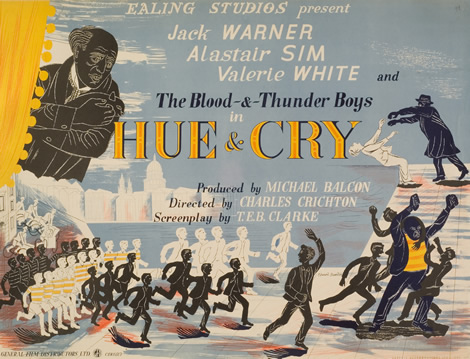
Considered as the first of the Ealing Comedies, Hue and Cry (1947) is a socio-realist thriller for children set amongst the rubble of post-war London. Scene after scene show swathes of a crumbling city. The ruins serve as a playground for the children and in an odd way a nurturing ground.


Hue and Cry tells the story of a gang of boys, Joe chief among them, who discover that a criminal gang are communicating to each other covertly through a comic book called Trump. He reaches out to the comic book's author, played by Alistair Sim (best known for his portrayal of Ebenezer Scrooge) for clues and begins to piece together the activities of the criminal gang. Little does he realise how close to the central figure of the criminal gang he is. Joe and his friends pursue a sinister lady who works for the publisher of the comic books as they suspect that she is is in cahoots with the leader of the criminal gang, played by Jack Warner masquerading as a fruit and veg seller in Covent Garden.

I was reminded somewhat of Luis Buñuel's Los Olvidados (1950), which shares the same social realist context featuring child protagonists growing up amidst poverty, yet in Hue and Cry we witness children living in poverty who do not turn to crime and delinquency but attempt to uncover the immoral actions of the adults.

For a film with a dark side, this is a light hearted romp through post-war London. Here the children are bold and triumphant and the adults are devious or disconnected and distant. 

This film is now considered culturally significant because it is one of the last to truly show the damage inflicted on London during the Blitz. In the years that followed, rebuilding projects would considerably change whole sections of the city, and in many ways this film preserves the memory of an older and now lost London.


It's a Barnum and Bailey world
Just as phony as it can be
But it wouldn't be make-believe
If you believed in me
'It's Only A Paper Moon' - Harold Arlen (1933


Utilising black and white much as with The Last Picture Show (1971), Peter Bogdanovich goes vintage again and captures the period, the dust, the radio (archived recordings of Jack Benny); the artefacts of a time gone by.

Paper Moon is the story of Addie (Tatum O'Neal) a girl who has lost her mother and needs to be relocated to her aunt's. A man called Moses (Ryan O'Neal) shows up at her mothers funeral, he is given the responsibility of delivering Addie to her aunt's. He might well be her father (Ryan O'Neal and Tatum O'Neal are father and daughter) but this will remain an unknown. Their relationship at first turbulent eventually evolves into a duo up to mischief and adventure. It's a beautiful little road movie about a rather unorthodox 'father/daughter' relationship.

The opening shot in Paper Moon

The film opens with the sound of wind rustling across the plains and the strains of the hymn 'Rock of Ages'. The beautiful opening shot of Addie has evokes Dreyer and Pasolini. Addie is a child of the depression and over the next decade and a half there will be many changes and advances which will define the America she has known, against the one that is to come.   

Addie listening to Jack Benny
Radio plays a crucial role in Paper Moon, and at every juncture Addie relies on it for escapism. She listens to Jack Benny and her frequent references to Frankie (Franklin Delano Roosevelt) contextualises the impact radio had on the population and how FDR's fireside chats connected the country and shaped the consciousness of the people.


Moses and Addie sit in a cafe, while a Will Rogers plays across the street
From the shots of Kansas, to the encroaching commercialism and images from the outside world present in the cafe Moses and Addie dine at it's clear the film presents an America undergoing great cultural and technological changes. Brand names and advertisements are seen on the walls and across the street a Will Rogers film, Steamboat Round the Bend (1935) plays. The American dream is epitomised by the caption 'Dream' which suggests the growing influence of cinema on the American way of life as a form of escapism but also as a medium for reflecting American culture back on itself  and in the process changing and reshaping the culture.

Moses and the hillbilly wrestle
Paper Moon depicts the evolution of the American way of life and the slow homogenisation of the smaller cultural cliques, state to state, town to town - the exchanges of the rural and the City. Much of this is is also represented by the difference between the small towns and the rural areas, highlighted particularly in a scene where Moses trades in his car for a truck and the hillbilly owner of the truck refers to him as a "city boy". The battle of town and country, quaint and new is established in the wrestling fight between the hillbilly's son and Moses.


 'Just around the corner there's a rainbow in the sky'

Things turn sour on the duo's adventure when they encounter a local bootlegger in Kansas and Moses and the music on the radio changes as well. The use of 'Down On The Banks Of The Ohio' by the Blue Sky Boys is perfectly placed after the previous scene which involved Moses discovering the woman from the carnival in bed with the hotel manager, a tryst arranged by Addie, resulting in Moses and Addie leaving for the next town. The song, a Murder Ballad, tells the tale of a man who murders his lover because she would not marry him. The song's theme outlines how Moses and Addie have entered the dark underbelly of American life, and is specifically more rural than the city-sounding tunes heard so far on their radio. It is a rural song about the real grit of love and death in a still wild untamed and morally abtuse land and perfectly placed as it showcases the transfer of early Folk (English to American) into early Country Music against the more refined and newer city tunes of Broadway and Tin Pan Alley. Unlike 'Ohio', 'Paper Moon' is a city song about dreams and aspirations in an increasingly plastic (or was it Bakelite?) world. The song underlines the darker scenes to follow where Moses and Addie discover that the bootlegger's brother is a crooked Sheriff.


There is a happy ending to Paper Moon. But it's certainly not entirely one of make believe. Addie arrives at the home of her aunt and given the choice to live the perfect American family life, she hesitates and returns to a reluctant Moses. The moment is bittersweet because she would rather remain on the road with him on a path of uncertainty and adventure and he would rather she remain with her aunt. This is a film of surfaces, of subtext, and the final scenes evoke this beautifully. Its not so much how the characters interact or what they say, there is an emotional intensity which suggests the feelings underneath the dialogue. There is no embrace between the two, but as with doubts about Moses denial that he is her father, you sense in the same way that deep down somehow he wants to her to come along with him after all.


The film is highly stylised. Wide shots and close-ups help evoke the sense of classic Americana, the relationships between the characters and their surroundings. Some of the establishing shots in the film are interesting in how they present characters against their environment, particularly in an early shot where Moses aims to swindle Mr Robertson out of $200 because of his brother's connection to Addie's mother's death. Here the perspective shots of the characters in relation to the car, the factory office and the factory, create a beautiful still image, in each case the small insignificance of the characters against their environment. There is something hyperreal about the dainty looking office (which looks much like an American home) against an overbearing industrial backdrop.


Paper Moon is framed by the song 'It's Only A Paper Moon', written by Harold Arlen. It was the sage advice of Orson Welles which resulted in Peter Bogdanovich naming the film Paper Moon. In fact Welles said it was so good that, "you don't even need to release the film, just put out the title on it's own". It was originally used in the film Take A Chance (1933), which was a rehash of a Broadway musical where two small time gamblers leave the carnival circuit to seek out fame and fortune. There is certainly something of this in Paper Moon when Moses forms a relationship with a women from a travelling carnival

1. Another Woman (1988) 


"I wondered if a memory is something you have or something you've lost" 

'Another Woman' is an example of life as deception, that to go on living we must deceive ourselves on more than one level and that some of us have a larger capacity to do this than others. Sometimes we awake from these little deceptions, sometimes it takes a great trauma or event for us to awake from the greater deceptions and sometimes the mirror of someone else's life is enough. 

Anyone who appreciates the films of Woody Allen is likely to include Manhattan, Hannah And Her Sisters and Annie Hall in their list of his best films. Over the next few weeks I'd like to suggest some more unlikely candidates, starting this week with Another Woman and following with one or two controversial choices.

Another Woman is a bit of a departure for Woody Allen, it's a quiet and thoughtful musing on love and regret in late middle-age. Perhaps Allen was reading Proust and thinking about Ingmar Bergman. Bergman's long-time collaborator Sven Nykvist is the cinematographer here. To an extent Allen's own stylistic voice is somewhat muted, although usual themes of love and neurosis are present; comedy is not the prevalent driving force here. Some will find the film deeply moving others may even find it boring for the same reasons. It is not one of Allen's better known works but it features a masterfully understated Gina Rowlands (best known for her work with John Cassavettes) and a sad, dreamy and watery-eyed Mia Farrow.

Rowlands plays the part of Marion Post a university professor who rents an apartment adjoining a psychiatrists office while working on a new book. She overhears a session in the psychiatrists office with a heavily pregnant and suicidal woman, Hope (Mia Farrow) and is drawn to the woman's story.

She becomes something of a voyeur initially but then begins to reflect on her own life, her marriage to Ken (Ian Holm) and another earlier love interest, novelist Larry (Gene Hackman). The conversations she overhears help reveal to her the cognitive dissonance she has lived with many years, the denials she has sheltered and the illusions she has fostered. She comes to realise that apart from her step-daughter who idolises her, she has both knowingly and unknowingly manipulated and hurt many of those close to her, and is seen by those in her periphery as often quite calculated.

Rowlands reminds me of a combination of characters, Ellen Burstyn in Alice Doesn't Live Here Anymore and for some reason Liv Ullman. Perhaps it's the Bergman influence. Rowlands was not the original choice for the lead part and although she is more well known for playing manically intense psychologically driven characters in her husband John Cassavette's films, here she gives one of the performance of her career, quiet and understated.


"For here there is no place
that does not see you. You must change your life.
"

 In one of the best scenes in the film, Marion reads Rilke's 'Archaic Torso of Apollo' from a book of poetry her mother once owned. She finds the line "you must change your life" underlined and her mothers teardrops staining the page. It underlines the film also.

Another Woman is an example of life as deception, that to go on living we must deceive ourselves on more than one level and that some of us have a larger capacity to do this than others. Sometimes we awake from these little deceptions, sometimes it takes a great trauma or event for us to awake from the greater deceptions and sometimes the mirror of someone else's life is enough.


I saw The Untouchables for the first time tonight. Bond always gets the best lines and the Oscar is well deserved even if his mastery of a Boston Irish accent sounds suspiciously Scottish

Robert De Niro's depiction of Capone is comic, verging on camp, but definitely a classic role.  It's surprising how much his part in the film was ridiculed at the time by Roger Ebert. I think of the part as a precursor to his later more comic work and alongside his role in Brazil it's a bit of light relief after the epic Once Upon A Time In America. A few years later a fellow 'serious actor' Al Pacino, would play an equally comic cartoonish Italian-American bad-guy role in Dick Tracy.

Kevin Costner playing the moral lynch pin, is very much the same part he would replicate for JFK.

The homage to Battleship Potemkin is a nice touch, but it's dramatised in such a way that it's more of a Naked Gun type spoof. The obvious homage was drawn out almost as laboriously long as the classic scene in Battleship Potemkin.

There is one particularly superb piece of incidental music scored by the legendary Ennio Morricone, 'Al Capone's Theme' really captures the comic subtleties of De Niro's Capone. The melody is an impish play on Gangster clichés, recalling the incidental music from The Godfather, it takes the stereotype turns it inside-out with the huge 80s reverb drums, funky bass and synthesizer. Morricone must have been familiar with De Palma's Scarface as there is something of Giorgio Moroder's insidious Scarface theme in there as well.


I am relatively new to Chris Marker, having seen only Sans Soleil (1985) and I feel almost shameful that his work has passed me by. Luckily (perhaps not for him) he died recently and so I was encouraged by a friend to check out his work. Sans Soleil reminded me of Koyaanisqatsi (1981) and Baraka (1992), but perhaps those are rather obvious comparisons, although chronologically Sans Soleil certainly sits nicely between the two.

Sans Soleil has this near Baudrillardian type aesthetic to it in both the monologue and the images, perhaps its this kind of dreamy new-age abstract-speak where everything seems vaguely poetic and vaguely profound or aphoristic. Often with Baudrillard there seems a beautiful illusion in the text and yet it communicates much about the modern world we live in, the space, time, memory, pace, and the interconnectedness of everything without ever really saying too much. This is certainly the case with Marker. There are also touches of Mark Rothko in the colossal stillness and grace that his film-work evokes and I also see kinship with Andrei Tarkovsky - Marker made the documentary One Day in the Life of Andrei Arsinevich (1999) - in the evocative imagery, the focus on memory and the recall of things lost; static images representing static moments, and the clashing together of half remembered life. Some of this is indeed also present in the work of Wim Wenders, notably Wings of Desire (1987)

However it was La Jetée (1962) a sci-fi (which served as the inspiration for Terry Gilliam's 12 Monkeys) composed only of still black and white shots (apart from one brief moment where we see the blinking of an eye) which floored me completely and most especially in its closing lines:
"He knew that the moment he was granted to see as a child was the moment of his own death."
La Jetée is unlike any sci-fi I have ever seen, certainly in the way the images are composed, although it retains the guy-falls-in-love-with-girl-but-can-never-attain-her trope which seems identifiable in a myriad of sci-fi from Nineteen Eighty Four (1984), Blade Runner (1982), The Spy Who Came In From The Cold (1963) to Brazil (1985) and more recent outings like Source Code (2011) and even Prometheus (2012). When I think of sci-fi I see that it is often significantly underpinned by a struggle or quest for life and knowledge and ultimately a struggle to find love. Sci-fi is often about a longing for someone or something lost, a fulfilment, a discovery, a memory, a moment of happiness and in most cases this always leads to a quest for romantic love, as with Plato's "love is the pursuit of the whole". All one has to do is look at science-fiction writer Philip K. Dick. The death of his twin sister within a year of their birth haunted him his entire life, so much so that she appears to have served as his muse and the primary reason he became a writer. His experiments with psychedelics and his belief in alternative realities seem connected to the shadow she cast not only in his life, but the traces of her still left in his mind. All great Art is born of loss, and her image, a girl with dark hair forever unattainable, recurs throughout most of his fiction. La Jetée certainly has something of this.

La Jetée captures beautifully the idea of the end contained in the beginning of the recursiveness and reflexivity of time and ultimately existence. We witness a man, a prisoner in a post-apocalyptic time period, who is sent back into the past to trace the memory fragment from his childhood of a woman he had seen on an airport platform and the witnessing of a man's death. The film traces his first encounter with the woman in a flea-market, his fascination with her and the pursuit of his love for her. Over 28 minutes this exquisitely brings us to the closing moments where he runs to meet the woman on an airport pier and is shot dead in his pursuit - becoming the man killed in his memory.

That is a synopsis in short, but between that concept of the end conceived in the beginning is a multitude of beautiful still shots guided by a poetically spoken narrative. The moment where the woman's eyes open and close as she lays in bed, which occurs about halfway through the film, has a dramatic affect, because the film up to that point had resisted the traditional film form of the moving image. It forces the viewer to completely absorb the still shots, perhaps to uncover more meaning than the steady motion of images might allow, and it then breaks this tension or spell, with a short release of movement. It has to be one of the most important moments in film history.

There are no other words to describe this film, just 28 minutes of still shots and a stunning spoken narrative. What La Jetée suggests is that we do not need to always rely upon the rapid movement of images to envisage meaning, to suspend reality or time. The still image can tell us more about the passing of time, about memory, about love, about loss, than the one thing we often think of as the companion of time, movement. Chris Marker shows us the poetry of stillness, but he also tells us something about life along the way.

---

The entire film can be viewed here:


The beautiful musical accompaniment by Trevor Duncan reminds me somehow of Georges Delores score for Godards's Le Mepris and even ever so slightly of the musical introduction to Her Song by Colin Blunstone (see all below).

(La Jetée - Girl Theme)

(Theme from Le Mepris)


(Her Song - Colin Blunstone)


 (Bruce Springsteen, Stadium of Light, Sunderland, UK. June 20th 20012)

OK so yesterday I made love to Bruce Springsteen for 3 hours and 4 minutes. The thing is there were at least several thousand others partaking as well.

Bruce Springsteen may be the last 'great' rock star. I hate to call him a rock star. But in a setting like the Stadium of Light there really isn't any other adjective to describe the type of show he puts on nor quantify the presence of the man there up on stage and his effect on an adoring audience.

Stadium Rock has a bad name in some circles and rightly so but there have been without a doubt some great fucking bands to have played in this setting many of who essentially created the form.


You can roll out the names, Led Zeppelin, The Who, Queen, The Rolling Stones and so on. Of course the bad name comes more from the kind of tripe doled out now on a regular basis to the unwashed unabashed cretinous masses from bands like... well do I have to name names? I'm sure you can all fill in the blanks... I'm sure their fans think they put on a great show. But I think they're all shit. And surely some think the same about Bruce. The difference is they're wrong and I am right.

There are of course bands who can reinvent what Stadium Rock means - as my friend Chris pointed out to me this afternoon - like the Flaming Lips. The Boss however is not about reinvention nor is he tripe for the cretinous masses who as far as I'm concerned don't really like music other than to do the ironing to or to numb their brains inbetween eating, sleeping and shitting.


Bruce means business and he gets right down to it without the histrionics and the light shows and the camp displays or even ironic post-stadium-rock, just raw sincere emotional energy surging through the performances and a great knack for knowing how to connect his audience, even if half of them are stood 100 metres away in the rain. He never overdid it, there wasn't a moment I felt was simperingly wet.

He is one of the last performers of his era to hold an audience of 50,000 in the palm of his hands and scatter their hearts like star dust simply by playing the harmonica intro to The River and then carry them through an emotional journey through the sadness of young love and the lack of opportunities afforded to a certain type of American Working-Class that he has been so expert at paying homage and recreating in his songs.


Highlights of yesterdays show in Sunderland were many and people can consult the setlists and make their own assumptions. Until I can listen to a bootleg or bother to consult the setlist properly myself I think the most important recollection of the gig was really the sustained energy level, the sense that he gives his all when he performs, that he is not a selfish performer, that he wants to unite his audience with the power of music and even at times in some shows he can go into that 'preacherman' thing, tonight where he did it I finally understood why and saw in this context why it was important. It had a transcendent effect on the audience most apparent during the sax solo in Tenth Avenue Freeze Out when the entire audience chanted "Clarence, Clarence, Clarence" repeatedly that I don't think there was a single person without a tear in their eyes.

Bruce can take his fans on a journey something you can share with him and something you share in the moment with all your mates and everyone around you, looking at each other saying, 'he's fucking brilliant isn't he'.. Men and women everywhere I stood want to make sweet love to Bruce Springsteen, not just because they love his music nor for his good looks and surprising agility for a rock 'n' roller of nearly 63 years, nor because the man as a whole is one of the last old-style greats from the the royal bloodline of songwriters from Woody Guthrie through Bob Dylan. He is a master songwriter and a master performer, but essentially you can tell even from 100 metres away that he's lovely fucking bloke too.


SETLIST
Badlands
We Take Care Of Our Own
Wrecking Ball
Death to My Hometown
My City of Ruins
Spirit in the Night
Does This Bus Stop At 82nd Street?
Jack of All Trades
Youngstown
Murder Incorporated
Johnny 99
Working on the Highway
Shackled and Drawn
Waitin’ on a Sunny Day
The Promised Land
Point Blank
The River
The Rising
Out in the Street
Land of Hope and Dreams

Encore

We Are Alive
Thunder Road
Born to Run
Hungry Heart
Seven Nights to Rock
(Moon Mullican cover)
Glory Days
Dancing in the Dark
Tenth Avenue Freeze-Out


Recently I've been going through quite a Paul McCartney phase. Some might even say that is ill advised. I came late to The Beatles 'proper', having been initiated by my friend Steven when I was fourteen or fifteen but with the result of only liking the occasional track, which in most cases were the Lennon tracks or the Harrison tracks, generally finding Paul's music saccharine, and dare I say boring.

The songs which featured on this list of Beatles dislikes were the typical moon/spoon stuff along with 'Hey Jude', 'Let It Be', 'Eleanor Rigby', and 'Yesterday' and so on. The only time I'd ever been taken aback by the song Yesterday, was out of context in a Mantovani type string arranged segment which featured in the film Once Upon A Time In America in between Ennio Morricone's beautiful theme score, other than that I couldn't bear to hear it.


The songs I gravitated towards back then were the more mystical dreamlike Lennon songs like 'Lucy In The Sky With Diamonds', 'Julia', 'Across the Universe' or the sincere every-note-counts of Harrison's 'Something' or 'Here Comes The Sun'. As pieces of music and sentiments I found them somehow more endearing, more enduring and more heartfelt and soulful than I did of the McCartney material, one exception being oddly, 'I Will' (which as saccharine as a choice it may be) was something I heard first covered (even more saccharine) by Art Garfunkel!

Now, on the flip side one could equally say that Lennon's mystical dreamlike songs were as indulgent as McCartney's were bland.

Other than that most of my musical obsession was taken up for a good few years by Bob Dylan and Paul Simon, at least until I turned 21 and was knocked out of the addiction and flung fully into the world of the world of music 'outside' of the Bob Dylan cradle thanks to a broken heart and a new set of mates with more diverse tastes in music.

Anyway, several years ago, after having had a quite strident, 'not interested' opinion on the Beatles aside from the odd track, I began to take them more seriously.

I think the thing that often turns people off The Beatles is the hype surrounding them and the esteem with which they are held, so that even before you've heard their music you know who they are and everyone thinks they're great. The inner contrarian/cynic in me was immediately turned off and decided to avoid these horrific Beatles at all costs.

At some point I got to see A Hard Day’s Night, and began to realise that behind these - what I thought of as - throwaway nursery rhyme rock n' roll songs, or songs you find in a 'Complete Keyboard Player' book in the homes of middle class parents, or a school music teachers idea of 'good' music, were these really satirical, ironic and hilarious figures who were not the sanitised bollocks I'd always believed them to be.

I distinctly remember as a young teenager leafing through my granddad Gibb's 'teach yourself how to play keyboard' to find among 'When The Saints Go Marching In', 'Hey Jude' and 'Let It Be' and deciding from then that everything that was wrong with the world, with music and with people must have something to do with those fucking abhorrent songs and those fucking 'Complete Keyboard Player' books. To this day I still hate 'When the Saints Go Marching In', 'Michael Row the Boat Ashore' and hope they along with every fucking moron who has ever played those songs on a keyboard marches into a fiery furnace of misery.

Anyways, getting back to my love for the Beatles. Seeing A Hard Day’s Night opened my eyes. These chaps were funny and talented and swept up in a new kind of entertainment world which they would serve as future role models. They hadn't had their spirits kicked out of them, the way these despicable Reality-TV-talent-shows now currently murder kids' spontaneity and sense of instinct and when you watched them performing songs from the album the movie takes its name, you realise how effortless and brilliant those melodies were, which can only have come from a mixture of the Rhythm & Blues they'd heard from vinyl shipped in from the states down on the Albert Docks when they were still tear-away teddy boys in Liverpool to the 'granny music' John accurately described as Paul's 'influence' from his father.

When you combine those two elements, and John, Paul, George and Ringo's equal love for Rock n' Roll and Country Music, you have what at that point was the future synthesis and model for modern popular music obviously...

Now getting to McCartney. I can leave Lennon aside, as I had always preferred his music, always thought of it as more emotional, visceral, subversive and sincere. 

My entry to McCartney's music was actually not via his Beatles output initially (I came to appreciate that again later), but his first - DIY - album McCartney and the second one Ram, which as far as I'm concerned are both brilliant. As far as DIY, McCartney set a standard, otherwise established as far as I can tell with Skip Spence's 1969 work Oar.

The linchpin without a doubt with McCartney was the song Junk, that beautiful nostalgic recollections of a junk shop where signs in the shop window wonder why. He gave the artefacts a humanity and married it with a beautiful sorrowful melody, and the fact that unlike some of his earlier work, it wasn't laden with gooey schlocky lushness, but was sparse, spare, a bit rough around the edges made it beautiful. Followed by 'Every Night', 'Oo You', 'Man We Was Lonely' and 'Teddy Boy' (a failed Beatles song Lennon hated, and which in another context I'd probably hate too). Again, taking the contrarian stance the typically honoured 'Maybe I'm Amazed' leaves me cold. Its shit Paul, shit.


So McCartney led me to Ram and the amazing 'Uncle Albert' et al, but most importantly to revisionism of his work with The Beatles and so began my appreciation of the man's music both as a writer and crucially as an arranger. You only have to hear his bass contributions to the other Beatles' work to see how he could lift a song up at the right places. Although Lennon was good at dropping a 'Spaniard' in the works with his wit and cynicism, his musical forms were far less advanced than Paul's, but at times they were equally spellbinding. 'Happiness Is a Warm Gun' is ample evidence of how great Lennon could be.

From there I went back to 'Penny Lane' and admitted to myself that I no longer hated it, I loved its nod to the Beach Boys. Then I decided I could stomach Paul's ode to the mysterious Eleanor (Rigby). Having previously thought it boring and farty to make up songs about imaginary people, their imaginary lives (although much evidence suggests she was real) and their lonely existence. Now I think of it as song craft, and admirable to a point. But further back you need only look at a song like Things We've Said Today, which has such a fantastic feel and melodically is gorgeous, never mind the obvious cliché choices people always comment on like 'Here, There and Everywhere', which is also a tremendous song.

I even came to almost like 'The Long And Winding Road' (mainly the piano playing), which had long been a song I had hated for its seemingly pointless sentiments leading to the irritating verse ending chords which cry out that 'daa daa, daa daa, daa'. McCartney certainly knows how to verge on elevator music and Lennon could bring him back from this abyss, but equally McCartney could save John from his indulgence of the self in song. Alas we have Ian Macdonald's book Revolution in the Head, so I may as well say no more on any of this.

The point I guess I'm trying to make is that although McCartney irritates me like the incessant drip in the bucket from a leaky ceiling, sometimes I think 'damn, that's a good fucking song'.

Aside from the first two records and obviously avoiding the utterly yuckifying Broad Street, I have steered clear of most of McCartney's other solo work and always kept a 'file for later' policy on 'getting into' more of his stuff. But in referring to the previous paragraph, sometimes I'm nicely surprised by a new song I had not heard before. Two examples of this were hearing 'Jenny Wren', from Chaos and Creation.. and 'Calico Skies'.

The guitar arrangement of the former song is in the classic Macca-Blackbird vein, but it's pretty, prettier than 'Blackbird', and a better song to boot (controversial?). The lyrics are pretty straightforward, but something about the song suggests it was an inspiration song, the guitar piece particularly. Although lyrically it could never match it, it somehow reminds me of how Dylan must have written 'Dark Eyes':

Like so many girls, Jenny Wren could sing
But a broken heart, took her song away

Like the other girls, Jenny Wren took wing
She could see the world, and its foolish ways

She saw poverty, breaking up her home
Wounded warriors, took her song away

For the guitar players out there, the song is down-tuned a tone and the change from Am to Cm is a beast, as is the standard picking change from Am to G to F on the 'breaking up her home' part.


Equally 'Calico Skies' had a similar effect on me. Again, like much of Macca's output the song could verge on the cheese-factor, specifically a video performance of it with him playing it by a crackling fire in a forest with his tracksuit bottoms on. Plonker. I've picked a live version to show below, because I enjoy the strings on it, more than the video footage of Paul playing it by a smoking fire! Although even the strings are slightly cheesy. Either way, great song Paul!

Interestingly, both songs, both just over two minutes in length and both seemingly inspiration songs which feel like they were written relatively quickly share a similiar sentiment about a cruel world outside, with Calico Skies referencing 'crazy soldiers' and 'weapons of war', and Jenny Wren, 'wounded warriors' and 'the broken world' and its 'foolish ways'.


Of recent there seems to be either a cunning PR campaign to revitalise his career or a general revisionism growing (or probably both) around McCartney's cultural role/impact in terms of an avant-garde musician with his interest in electronic music and his apparent love of early experimental music/music-concrete. I had been one who thought of this revisionism in the various music magazines, as rather annoying cynical ploys to reinforce his influence as the Beatles, sell more records and compete with Yoko Ono's genius John Lennon branding.

Having gone through my own revisionism of his work, it seems that in the mainstream at least there is no need to reinforce his credentials, as apart from the young muppets on Twitter asking 'Who the F&*% is Paul McCartney?' after his recent Grammy outing, most know who he is and certainly out of the mainstream enough people appreciate the best of his work. Yet even where I think the arguments (tied in with the 'Carnival of Light' debate) for this 'McCartney as the experimenting Beatle' are weak, there is some importance in this revisionism in that it reminds people that amongst the schlock and the clangers, there are some real diamonds that should be heard.

Having already expressed my hatred of 'The Complete Keyboard Player' manuals and the like I will step back slightly from that. One thing I think crucial about McCartney is how influential a piano player he is. Something that I haven't seen mentioned much. You can pretty much guarantee that students of music theory will have at some point learnt what I had viewed as those atrociously bland and boring songs 'Hey Jude' and 'Let It Be' at music lessons and that essentially the style in which they played those songs came directly from Paul McCartney’s own fingering technique.

Paul McCartney, a self-taught - dare I say - raw and 'natural' musician (whose musical scope and melodic ear is pretty astonishing) who in fact has probably influenced a million student piano players and future classically trained musicians and songwriters perhaps even unconsciously in their playing of piano and in their composition. There are positives and negatives to this obviously, on the negative someone boring like Jamie Cullum or even Chris Martin when that silly prat gets anywhere near a piano.

Even more crucially, McCartney is not hailed as a great piano player, yet most of the kids who learn piano will have within their playing style, especially if they follow the educational playbooks, something of McCartney’s instilled within their own, that unmistakeable piano sound that you hear on 'Hey Jude', 'Let It Be' or even 'The Long and Winding Road' have been the basis for many kids to learn piano. Even back when I was at secondary school you'd hear the trickles of those songs flowing down from the music rooms as the teacher tried to teach the kids a 'modern' song instead of a Mozart or whatever else. That's probably why I always hated those songs, because i associated them with institutions and establishments and they seemed to fit so nicely into the worst elements of taught music because they were not idiosyncratic, but in a sense definitive, concise and easy examples of 'how to play'. His playing is almost a lesson in instruction for piano, basic chord patterns, roots and fifths and the switches between them and underneath deceivingly simple and catchy melodies. Look at any musician, who was generally tutored whether at school or privately and somewhere within their style is Paul McCartney and the traces of his Granny Music.

Equally, the same can be said of his guitar style specifically on 'Blackbird'. These two points are something I can't imagine (no pun intended) apply in the same way to John Lennon or Bob Dylan or any other songwriter, although a couple of Lennon's songs, particularly 'In My Life' which have something of the McCartney feel, also have that classic Lennon trope, shift from major to minor on the IV chord (e.g. C to Cminor in the key of G) which has found it's way into the popular song.

So, sorry Paul for not giving you credit where credit was due sooner. I still think you need a kick up the arse sometimes, and although your songs don't always move me soulfully or emotionally you're one hell of a song crafter and musician and an absolutely necessary tonic to people in the John Lennon camp, who can be as loathsomely indulgent as you can sometimes be loathsomely bland.